Ten Outfits That Did the Talking: A Love Letter to Costume Design
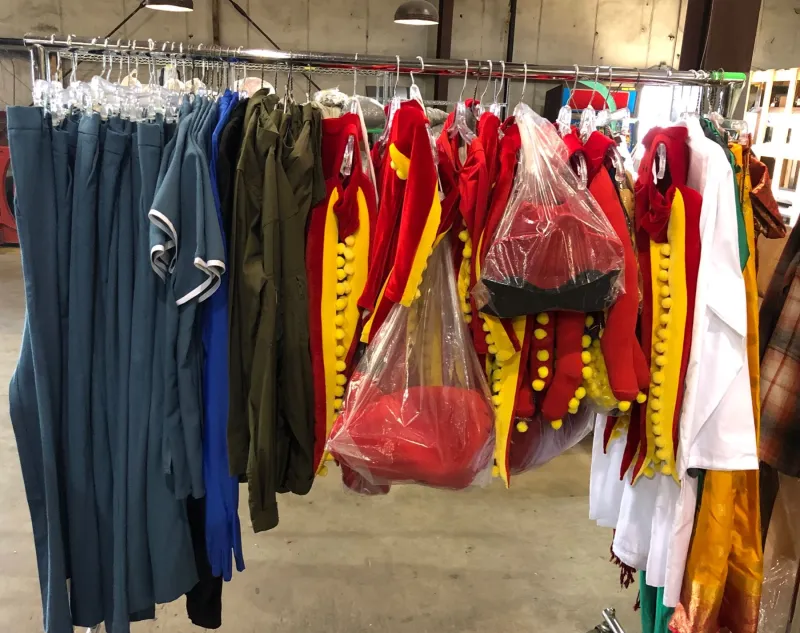
Photo: vintage costume rack film set wardrobe clothes, via dygtyjqp7pi0m.cloudfront.net
There's a moment that happens in almost every film you love, and you've never noticed it: roughly ninety seconds in, you've already formed a complete theory about the main character. Their income, their self-image, their grief, their ambition. Nobody told you any of this. Their clothes did.
Costume design is the most misunderstood job on a film set. People assume it's shopping. In reality, a costume designer is doing character work alongside the writer and the actor — sometimes ahead of both. A wardrobe department doesn't dress a movie; it writes the parts of the script that never made it to dialogue.
The Sweater Theory of Character
Consider how much information a single garment can carry. A frayed cardigan worn by a grandmother in a family drama instantly establishes decades: the marriage, the frugality, the refusal to update. Put the same actress in a crisp blazer and you've made an entirely different film about the same woman.
This is the de-aging and re-aging power of clothing. Designers routinely make actors look younger or older without a single visual-effects shot — a high-waisted jean, an oversized sweatshirt, a haircut-hiding hat. Time travel on a budget.
Superhero cinema turned this semiotics game up to eleven. The suit is the thesis statement. Watch how costume teams signal moral alignment through texture alone: matte fabrics for the brooding, gleaming armor for the corporate, weathered leather for the one who's been doing this too long. When a hero's suit gets damaged or dirtied across a film, that's an arc rendered in textile. When a villain's wardrobe sharpens scene by scene, that's a descent you can track like a chart.
Ten Costumes That Told a Whole Story Without a Word
A short, subjective syllabus in silent storytelling:
- The white midi dress and apron, The Help — Uniform as social architecture; you can read an entire power structure in the cut of a dress.
- Rose's boarding-school corsetry, Titanic — Literal constriction as class commentary, loosened in step with her liberation.
- Daniel Plainview's dust-caked work coat, There Will Be Blood — A man who stopped caring how he looked the moment he started winning.
- The green silk dress, Atonement — One nightgown-adjacent gown carrying a whole evening of longing and ruin; often cited as the best costume of the century so far.
- Arthur Fleck's mismatched layers, Joker — A wardrobe assembled from whatever fits, sharpening into the red suit like a threat.
- The pastel uniforms of The Grand Budapest Hotel — Candy-colored precision that makes the film's grief land harder by contrast.
- Tonya Harding's hand-sewn competition costumes, I, Tonya — Sequins on a budget; ambition you can hear rustling.
- Jo's scuffed boots and ink-stained cuffs, Little Women — A working writer rendered entirely in wear-and-tear.
- Evelyn's rumpled audit-day cardigan, Everything Everywhere All at Once — A life of deferred dreams, worn open over a stained shirt.
- The pink and blue ensembles of Barbie — Costumes as worldbuilding, ideology, and punchline simultaneously.
Notice what these have in common: not one of them is decorative. Each is an argument.
Why the Oscars Keep Getting This Wrong
Costume design awards tend to go to period spectacle — corsets, capes, eras. And fair enough, the craft on display is often staggering. But the discipline's real magic is usually in the contemporary film, where the designer has no historical costume rules to lean on and must make a Kmart-adjacent wardrobe feel like destiny.
The next time a movie makes you feel like you've known a character forever, rewinding to check: you probably met them at the clothes. Somebody chose that sweater. Somebody chose the fraying at the cuff. Somebody decided, months before you ever sat down, exactly who this person was going to be — and then let the fabric do all the talking.