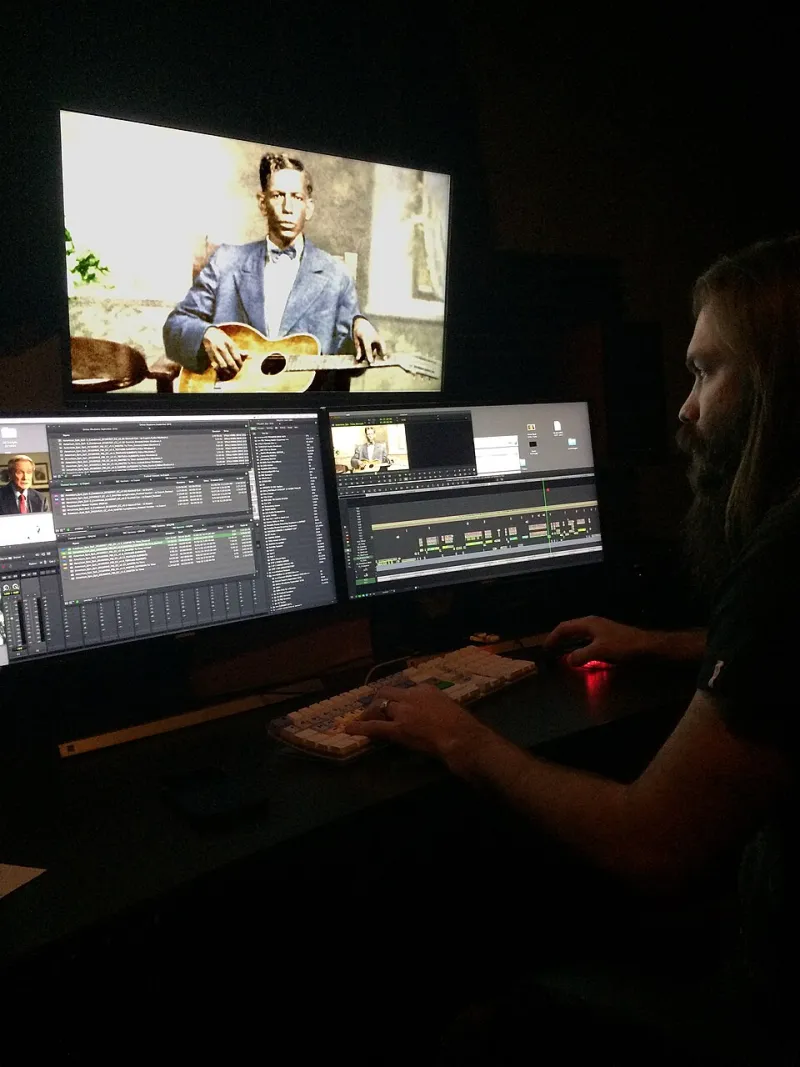
Runtime Roulette: How Streaming Giants Are Quietly Pressuring Directors to Cut Before You Ever Hit Play
Photo: Marcin Wichary from San Francisco, U.S.A., CC BY 2.0, via Wikimedia Commons
There's a version of a film you'll never see. Not because it was lost in a studio fire or buried in a vault somewhere. It exists — or it did, in a rough cut on a hard drive in a director's editing bay — before the conversation happened. The one where a platform rep, armed with engagement data and drop-off graphs, explained that viewers tend to abandon anything past the 94-minute mark. And just like that, twenty minutes of a filmmaker's vision quietly disappeared.
This isn't a conspiracy theory. It's an increasingly common reality for directors navigating the streaming era, and it's reshaping cinema in ways most audiences never get to see — or even know to miss.
The Algorithm Has Notes
For decades, the classic Hollywood power struggle was between directors and studios. Everyone knows the stories: Terry Gilliam vs. Universal on Brazil, Ridley Scott fighting for Blade Runner, the legendary chaos behind Heaven's Gate. The battle over final cut was brutal, public, and at least legible. You knew who the villain was.
The streaming era has made that fight murkier. Now the pressure doesn't always come as a direct order. It arrives dressed as data. Platforms like Netflix, Amazon Prime Video, and others have access to extraordinarily granular viewer behavior — exactly where people pause, rewind, or abandon a film entirely. That information is powerful, and it doesn't stay in a back-office analytics report. It filters into development meetings, notes calls, and the quiet expectations placed on filmmakers before a single frame is shot.
"It's not that anyone tells you to make it shorter," one independent director who recently released a feature through a major streaming service told us, speaking on condition of anonymity. "It's more like you absorb the culture. You know what they want. And you start making choices in the edit that you wouldn't have made otherwise."
That self-censorship — the kind that happens before anyone officially asks for it — might be the most insidious development in modern filmmaking.
Completion Rates vs. Artistic Integrity
Here's the core tension: streaming platforms measure success differently than theaters do. A box office hit lives and dies by opening weekend grosses and word-of-mouth legs. But on a streaming platform, what matters is whether subscribers keep their subscriptions — and one of the metrics that feeds into that is whether people actually finish what they start watching.
Completion rate, as an internal benchmark, incentivizes a very specific kind of filmmaking. Tight. Propulsive. Efficient. Nothing that lingers. Nothing that breathes. A slow-burn character study that takes 40 minutes to find its footing might be a masterpiece — but if 60% of viewers bail at the half-hour mark, the algorithm doesn't care about the third act payoff.
The result is a quiet but steady pressure toward a certain kind of movie. Not necessarily a bad movie. But a particular movie. One optimized for sustained attention in an environment specifically designed to distract you.
"You're essentially editing for someone who has their phone in their hand," says a veteran film editor who has worked on both theatrical and streaming projects. "That's a different animal than editing for someone sitting in a dark room with nowhere to go."
The Extended Cut Is Becoming a Relic
Remember when director's cuts were a whole event? Ridley Scott's extended Kingdom of Heaven turned a mediocre theatrical release into something genuinely great. James Cameron's Aliens director's cut recontextualized the entire film. These were cultural moments — evidence that the original release was a compromise, and that somewhere out there was the real version.
Streaming was supposed to make that easier. No physical media constraints, no theater scheduling pressures. A director could theoretically release their full vision directly to millions of subscribers overnight.
In practice, it's worked out almost exactly backwards. Rather than platforms becoming a home for expansive, director-driven cuts, they've become another layer of constraint. Longer runtimes mean higher production costs per minute of content, and platforms are increasingly cost-conscious after years of spending wars. More importantly, a three-hour cut that tanked in completion metrics is data that haunts a filmmaker's next pitch.
Some directors have pushed back successfully. But they tend to be the ones with the leverage to do it — the established names, the prestige brands. For mid-career and emerging filmmakers, the calculus is much harsher. Take the deal, hit the runtime, protect the relationship, and hope the next project gives you more room.
What Gets Lost in the Trim
It's worth asking specifically what kind of filmmaking suffers most under these conditions. And the answer, pretty consistently, is the stuff that takes time to work.
Character development that unfolds slowly. Tonal shifts that need space to land. Scenes that exist not to advance plot but to establish a world, a feeling, a relationship. The stuff that makes a movie feel lived-in rather than engineered. These are the minutes that tend to go first when someone's looking for fat to cut.
There's also a genre dimension here. Certain kinds of films — intimate dramas, slow-horror, literary adaptations — are particularly vulnerable because their pleasures are the hardest to defend with data. A jump scare registers in engagement metrics. A quietly devastating performance in a long, dialogue-heavy scene is harder to quantify.
Is There a Way Out?
Not everyone is pessimistic. Some filmmakers see the theatrical experience as a genuine refuge — a space where runtime is still governed by artistic logic rather than subscriber retention. The recent resurgence of ambitious theatrical releases, including films that push past the two-and-a-half-hour mark without apology, suggests that audiences will still show up for the real thing when given the chance.
There's also a growing conversation in the industry about transparency — whether platforms should be clearer about the creative constraints they impose, and whether filmmakers should have more contractual protections around final cut in streaming deals.
But for now, the invisible edit continues. Somewhere tonight, a director is sitting in an editing bay, looking at a scene they love, and doing the math on whether it makes the cut. Not because it doesn't work. Because the algorithm might not think so.
And that's a loss — even if you never know what you missed.